Before the Close-Up: How Early Cinema Made Faces Legible
Early cinema close-ups made faces and objects legible at a new scale, helping viewers read expression, follow story details, and notice what the frame left out.
Why did early cinema close-ups bring a face so near that the rest of the scene seemed to fall away? In films made during cinema’s early decades, a close view could make a glance readable, isolate a story detail, or interrupt a wider composition with a sudden change of scale.
Close-up scale
A close-up frames a person or object much larger than it appears in a wider view, often isolating a face or a telling detail. Its meaning depends on the image around it: a face filling the frame feels different after a crowded room than after another face at the same scale.
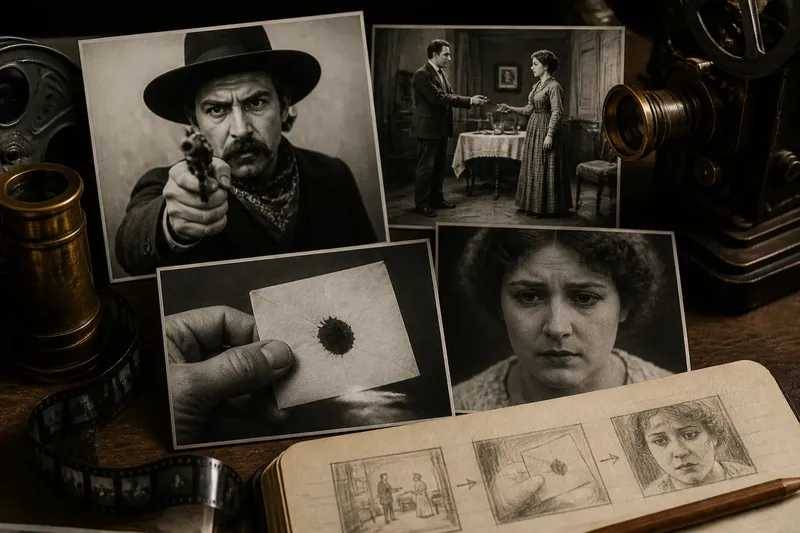
Early cinema did not settle on one standard framing vocabulary all at once. For example, Edwin S. Porter’s 1903 film The Great Train Robbery includes a close view of a gunman firing toward the camera, presented as a striking attraction as well as part of the film’s story. Other close views could clarify an object or make a performer’s expression central. These uses varied by film and moment; there was no single, uniform early-cinema convention.
The term “close-up” describes a scale, not a fixed emotional effect. A tightly framed face may seem intimate, alarming, comic, or unreadable. The effect comes from the relation between the visible face, the surrounding scene, and the moment when the framing changes.
Stage-like distance
Many early films used a fixed camera and compositions that kept performers visible from head to toe, with doorways, furniture, or several actions arranged in the same view. This staging can resemble a theatrical scene, but it should not be treated as a complete account of early cinema: framing and camera placement differed across films and filmmakers.
A broad view makes bodies and movement easy to follow. It can show who enters, where an object sits, and how one performer reacts to another. Large gestures also remain legible when the face is small in the image. The wider frame is therefore a storytelling choice, not merely a failure to move closer.
That distance leaves some details difficult to read. A hand might cover a token; a glance might signal recognition; a face might change before the body moves. Bringing one of these details forward lets a film redirect attention without relying on an enlarged theatrical gesture.
Faces and performance
Moving closer altered the relationship between expression and gesture. In a wide view, a performer might lean, turn, or raise an arm to make intention visible. In a close view, a slight tightening around the eyes or a hesitant mouth can hold attention. The face becomes not just the source of emotion but a surface the viewer is invited to inspect.
This did not mean that subtle acting suddenly replaced broad performance. Emphatic movement remained useful, especially in compositions that showed the full body. As films used tighter images, performers and directors could adapt gesture to the available space. A movement that reads across a stage may seem overstated when the face dominates the screen.
Framing also changes the meaning of a pause. At a distance, a motionless character may seem to wait while the scene continues around them. Close in, a held expression can make the pause feel active: the viewer watches for doubt, recognition, or a decision taking shape. The film has made stillness something to read.
Objects and attention
Close views could give emotional emphasis, but they could also clarify an object or action. A hand, letter, tool, or other detail enlarged in the frame may help viewers follow a plot point. A sudden close view can also create surprise or humor, or present a performer’s face as an attraction in its own right.
These functions can coexist. A close view might first show a clue, then direct attention to a character’s response. The object supplies information; the face supplies a reaction whose meaning may remain uncertain.
Imagine a silent scene that begins with a character at a table in a plainly furnished room. A folded note lies near the edge. The film cuts to a close view of a distinctive ink mark on the note, then to the character’s face, where a smile fades. Viewers can now see that the mark matters and that the character’s response is troubled, though the film has not yet explained why.
What a close-up changes
A close-up removes much of the room, other bodies, and the paths through the setting. That restriction directs attention, but it also withholds context. Viewers must remember the wider scene or infer what lies beyond the frame.
Think of the frame as a window narrowed by a sliding shade. The view becomes more selective, not more complete. A close-up can make an expression easier to see while making a character’s physical circumstances harder to judge. That tension can make the image feel intimate and unsettling at once.
Distance also shapes the viewer’s relation to a performer. A full figure can be observed as part of a group or environment; a close face can seem to address each viewer individually. That apparent intimacy is not the same as access to a character’s thoughts. A face may show a response while leaving its cause uncertain.
Close-up questions?
Who invented the close-up?
There is no single inventor to name. Filmmakers in different places used enlarged views for different purposes as framing, staging, and editing developed.
Was a close-up always emotional?
No. It could clarify an object, create a visual joke, present a performer to the audience, or make an expression central. Emotion is one possible use, not an automatic property of a tightly framed face.
Did early actors change how they performed?
Performance varied with framing, but the change was gradual and uneven. Broad gestures remained useful in distant compositions, while tighter views made smaller facial movements easier to notice.
Why can an early close-up seem strange now?
Modern viewers often expect a change in scale to connect smoothly to a character’s attention or to a detail in the scene. An early close view may instead function as a striking display, making its purpose less familiar than its framing.
Reading early cinema close-ups
Use these prompts to track what a close view does. For each item, compare the image immediately before the close-up with the image immediately after it.
- Check whether the close view shows a face, an object, or both; if it shows a face, track the reaction, and if it shows an object, identify what story detail it makes visible.
- Check whether the close view clarifies an action; if it does, connect the detail to the action, and if it does not, consider whether the sudden scale change works as an attraction or interruption.
- Check what the wider framing showed; if a person, object, or route disappears, keep that missing context in mind, and if nothing important disappears, treat the close view as a stronger emphasis rather than a full change of information.
- Check what happens directly before the cut; if a character looks toward the detail, connect the close view to that gaze, and if no such cue appears, consider whether the film is presenting the image independently.
- Check what happens directly after the close-up; if the film returns to the same action, read the close view as part of its continuity, and if it shifts elsewhere, consider whether the detail has introduced a separate beat.
- Check whether the face’s expression has a clear cause in the scene; if it does, connect expression to cause, and if it does not, leave room for uncertainty instead of treating the face as a complete explanation.
For instance, imagine watching a scene in which a character stands beside a desk, looks down, and appears in close view holding a key. The key’s shape is clear, but the earlier wide shot showed a locked drawer that disappears from the close framing. You can decide that the close-up clarifies the object while withholding its setting; when the film returns to the desk and the character tries the key, the action connects the detail to the drawer.
Early cinema close-ups made a new unit of storytelling available: a film could move from a room full of visible action to one face or object, asking viewers to attend to a smaller detail. When you encounter an abrupt close view, notice not only what the film brings near but also which parts of the earlier scene you need to keep in mind.